
Can a Double Storey Extension Be Built Under Permitted Development?
A professional architect’s guide to what Class A of the GPDO 2015 actually permits — and where the rules severely limit what you can build.
Table of Contents
- Introduction to Permitted Development Rights
- What Are Permitted Development Rights?
- The Relevant Legislation
- Five Key Rules for Double Storey Extensions
- Practical Complications That Catch People Out
- Why PD Extensions Often Disappoint
- When Planning Permission Is Required
- What to Do Next
Introduction to Permitted Development Rights
One of the most common questions homeowners ask when planning to extend their property is: “Can I build a double storey extension under permitted development?”
The short answer is yes — but only in very limited circumstances. And from an architectural perspective, the reality is often disappointing.
As architects specialising in residential extensions, we regularly assess properties for permitted development (PD) potential. What we’ve learned is that while the legislation technically allows two storey rear extensions without planning permission, the constraints are so restrictive that the resulting first floor space is often barely functional.
This guide draws directly from the Town and Country Planning (General Permitted Development) (England) Order 2015 (the GPDO) and the government’s Technical Guidance for Householders. It sets out exactly what you can build under Class A permitted development rights — and, crucially, explains why most homeowners are better served by submitting a full planning application.
Important: Permitted development rights do not override Building Regulations or the Party Wall Act. Always seek professional architectural and structural advice before proceeding with any extension works.
What Are Permitted Development Rights?
Permitted development rights are a set of national planning permissions granted by Parliament. They allow certain types of building work to be carried out without needing to apply for planning permission from your local council.
For residential properties, these rights are set out in Part 1 of Schedule 2 to the GPDO 2015. They cover:
- Enlargements and extensions to your home
- Roof alterations and loft conversions
- Porches and outbuildings
- Changes to windows and doors
The intention behind PD rights is to allow homeowners to improve their properties without going through the planning system where the impact would be minimal. However — and this is the critical point — double storey rear extensions are subject to much stricter limits than single storey extensions.
Article 4 Directions and Removed Rights
Before assuming you have PD rights, you must check whether they’ve been removed. Local authorities can withdraw PD rights by issuing an Article 4 Direction — common in conservation areas, national parks, and areas of outstanding natural beauty.
Rights can also be removed by conditions attached to previous planning permissions on your property. Always check with your local planning authority before proceeding.
The Legislation: Class A, Part 1, Schedule 2 GPDO 2015
All extensions to dwelling houses fall under Class A of Part 1 of Schedule 2 to the GPDO 2015. This section permits:
“The enlargement, improvement or other alteration of a dwellinghouse”
But this permission is subject to a detailed set of limits and conditions. For double storey extensions, these restrictions are particularly onerous.
The “Original Dwelling House” Concept
One of the most important concepts in PD legislation is the “original dwelling house”. This is defined as:
- The building as it existed on 1 July 1948 (if built before that date), or
- The building as it was first constructed (if built after 1 July 1948)
This means that any previous extensions — whether built by you or a previous owner, and whether under PD or planning permission — count towards your total allowance. You cannot reset the clock by removing an old extension.
The Five Key Rules for Double Storey Extensions Under Permitted Development
Here are the specific restrictions that apply to two storey rear extensions under Class A:
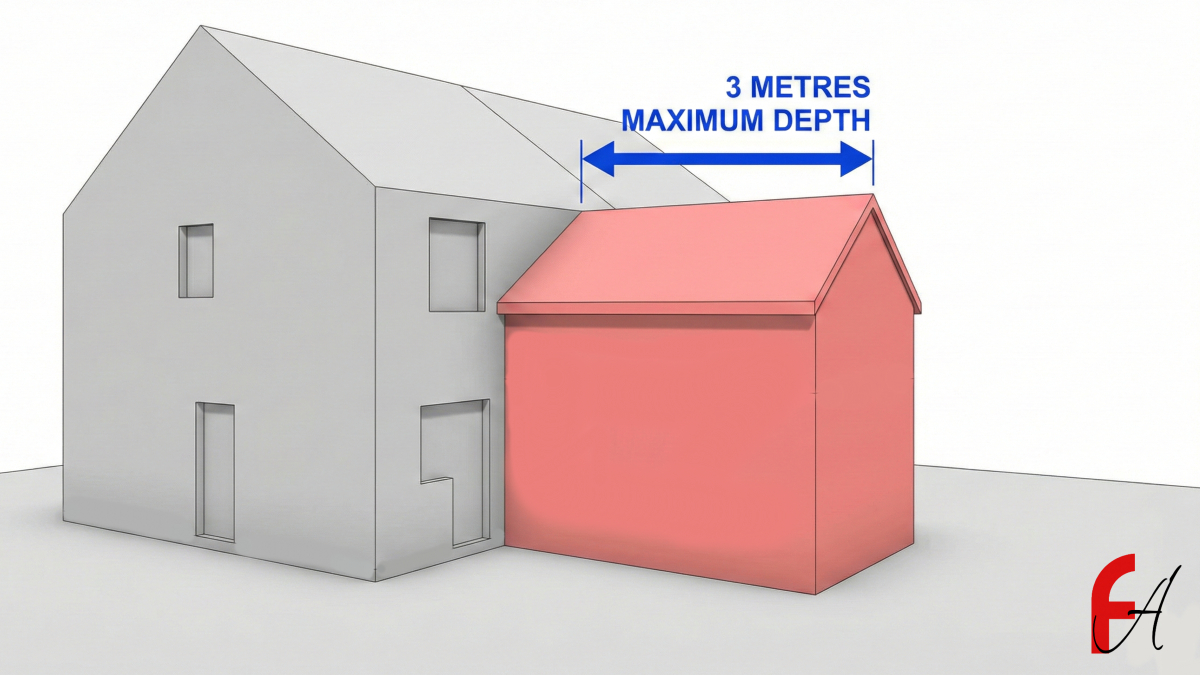
1. Maximum Depth: 3 Metres Only
Under paragraph A.1(h), where the extension has more than one storey, it must not extend beyond the rear wall of the original house by more than 3 metres.
This applies to all house types — detached, semi-detached, and terraced. There is no flexibility on this limit.
Key Point: Measurement is taken from the base of the rear wall of the original house to the outer face of the extension wall (excluding gutters).
In practice: 3 metres at first floor level delivers very little usable space. Once you account for wall thickness and staircase access, you’re left with a room barely deep enough for a bed or desk.
Compare this to single storey extensions, which can extend up to 8 metres (detached houses) or 6 metres (other houses) under the neighbour consultation scheme. The difference is stark.
2. Height Restrictions: Ridge and Eaves
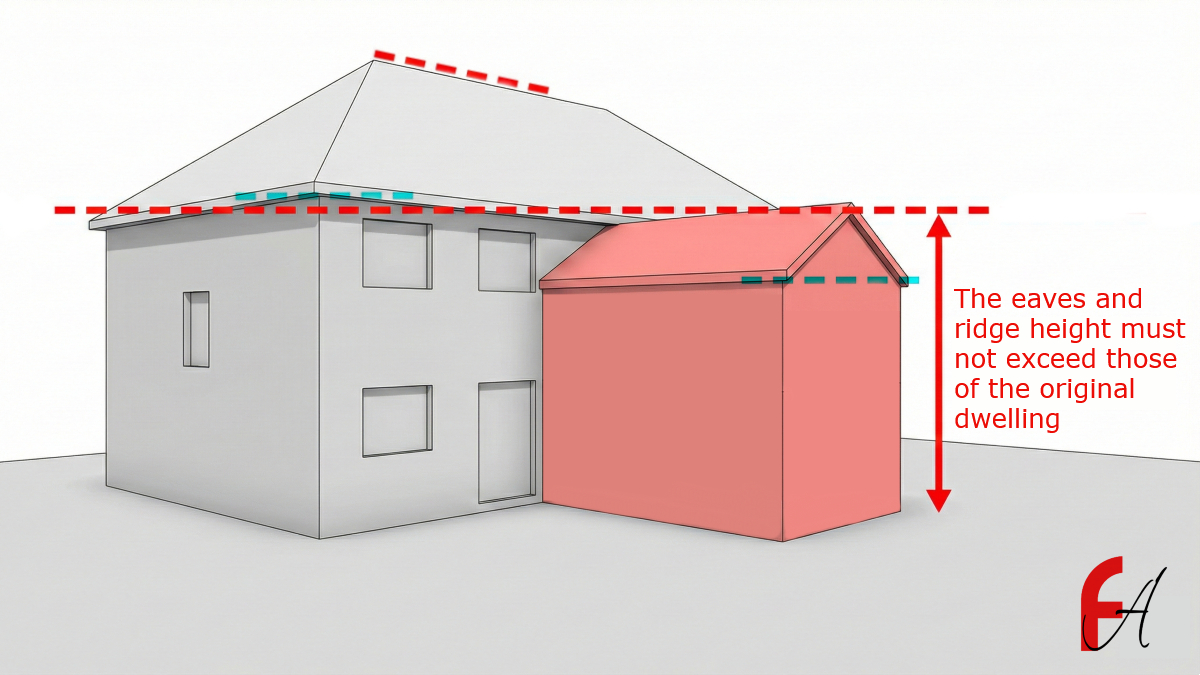
Two separate height limits apply under paragraphs A.1(c) and A.1(d):
- Ridge height: The highest point of your extension cannot exceed the highest part of the existing roof (the ridge line)
- Eaves height: The eaves of your extension cannot be higher than the eaves of the existing house
The eaves are measured from ground level at the base of the wall to the point where the wall meets the underside of the roof slope. Overhanging eaves and parapet walls are excluded.
What this means: Your extension’s roof must fall entirely within the existing roofline envelope. For most properties, this forces you into either:
- A flat roof (with reduced first floor headroom), or
- A mono-pitch lean-to roof tucked under the existing eaves
3. The 7 Metre Rear Boundary Rule
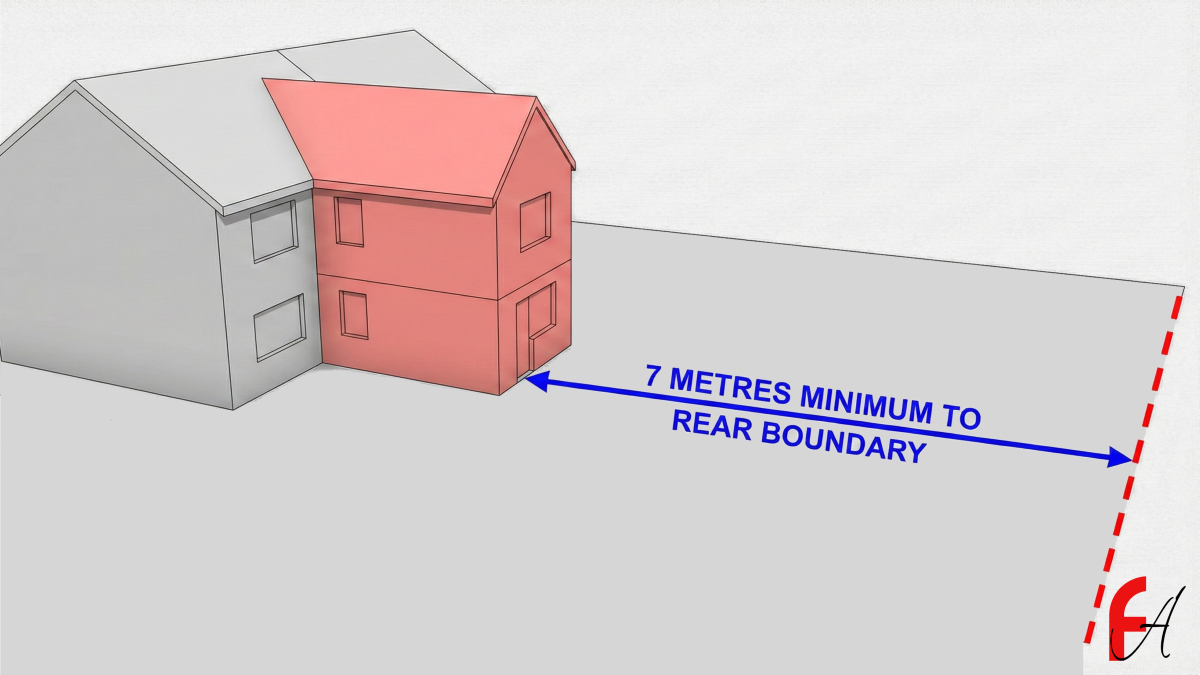
This is one of the most frequently overlooked restrictions. Under paragraph A.1(h), any multi-storey extension must be at least 7 metres away from the boundary opposite the rear wall of your house.
In simple terms: if your rear garden is less than 7 metres deep (measured from the rear wall of your proposed extension to the rear boundary), a double storey PD extension is impossible.
Common mistake: Many homeowners with small rear gardens overlook this rule entirely. It’s one of the primary reasons double storey PD extensions fail.
4. The 2 Metre Boundary / 3 Metre Eaves Trap
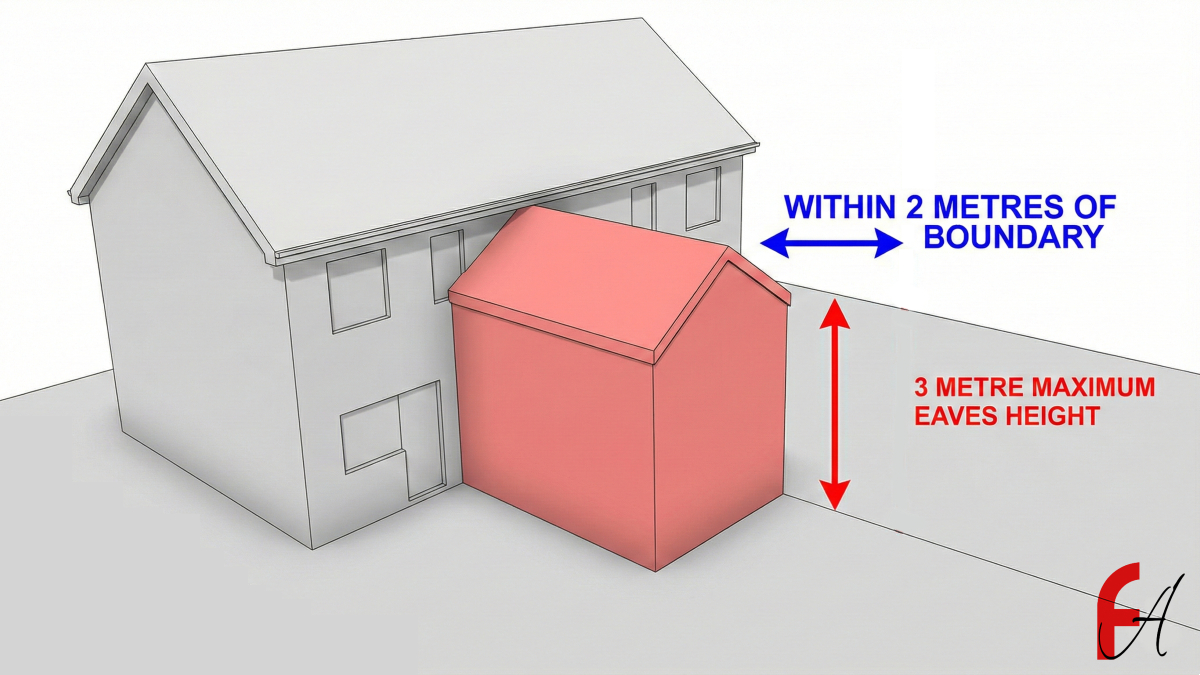
This is arguably the most restrictive rule for double storey extensions under PD.
Under paragraph A.1(i): if any part of your extension is within 2 metres of a side boundary, the maximum eaves height is capped at 3 metres.
Why this matters: A functional first floor room needs approximately 2.4m clear ceiling height. Add the ground floor ceiling, first floor structure, and roof build-up, and you need eaves around 5.5–6m high.
A 3 metre eaves limit makes this impossible. The resulting first floor will have severely sloping ceilings and minimal usable space — often too cramped to be habitable.
Architect’s view: We see this rule kill more double storey PD projects than any other. Properties on typical UK plot widths almost always have at least one side boundary within 2 metres. The resulting first floor space is rarely worth building.
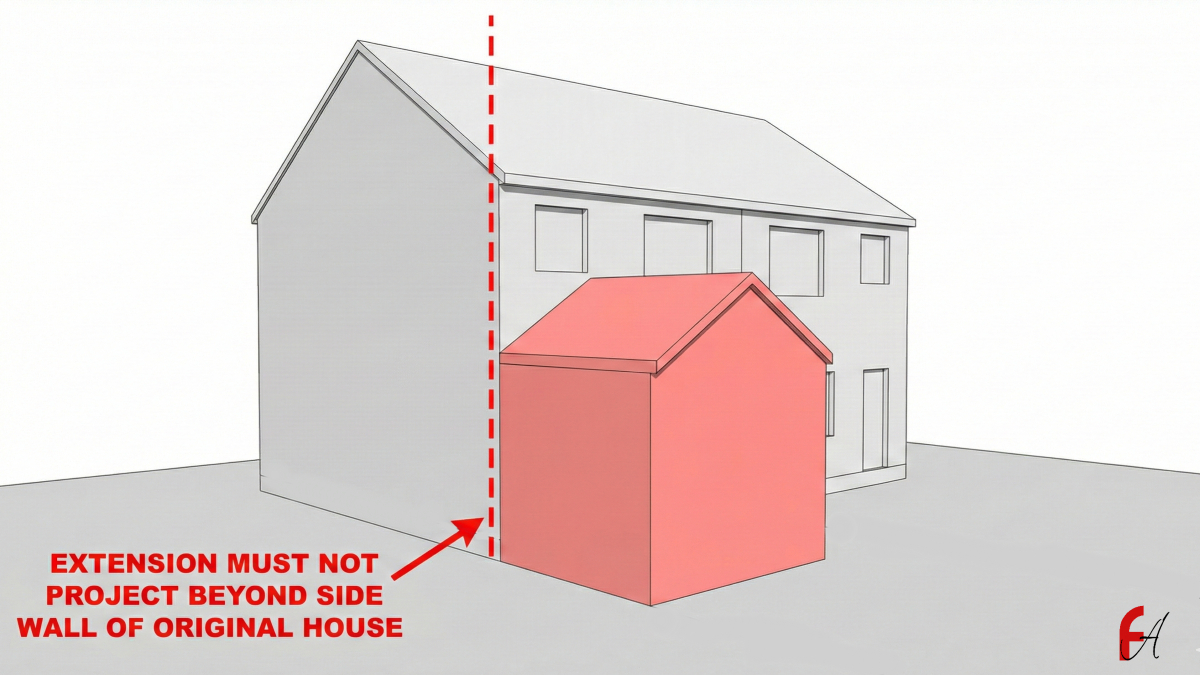
5. No Double Storey Extensions Beyond a Side Wall
Under paragraph A.1(j), if your extension projects beyond any side wall of the original house, it:
- Can only be single storey
- Cannot exceed 4 metres in height
- Cannot be wider than half the width of the original house
In plain English: If your proposed extension steps sideways beyond the original footprint of your house — even by a few centimetres — you cannot add a second storey under PD.
Double storey permitted development extensions must sit entirely within the width of the original house and extend only to the rear.
Practical Complications That Catch Homeowners Out
Even if your proposed extension appears to comply with the five rules above, there are several additional complications that can derail a PD project:
Existing Extensions: The Cumulative Enlargement Rule
Under paragraph (ja) of Class A, where a new extension is joined to an existing extension, the limits apply to the total combined enlargement — not just the new bit.
Example scenario: Your house already has a 3m deep single storey rear extension (built 20 years ago under PD). You now want to add a first floor above it. Even though you’re not extending any further back, the combined structure is a 3m deep, two-storey extension — which uses up your entire PD allowance.
Worse: if the existing extension projects 4 metres, you cannot add a first floor at all under PD, because the total multi-storey depth would exceed 3m.
Roof Alterations: The Class B Overlap Problem
This catches many homeowners by surprise. If your double storey extension has a pitched roof that connects to the main house roof — for example, with a gable end — your works must also comply with Class B (roof alterations).
Class B limits the additional roof space you can create to:
- 40 cubic metres for terraced houses
- 50 cubic metres for semi-detached and detached houses
Critically, this allowance is cumulative. If you’ve already had a loft conversion that used up the 50m³ allowance, you cannot now add a gable-ended extension that ties into the roof — even if it otherwise complies with Class A.
Result: Your only option may be a flat roof, which further reduces first floor headroom and makes the space even less functional.
Sloping Ground: The Hidden Constraint
Height is always measured from ground level, defined as the highest part of the ground immediately adjacent to the building.
On a sloping site where the ground rises towards the house, this can add 300–600mm (or more) to the effective measurement datum — dramatically reducing how much headroom you can achieve within the eaves height limit.
What looked viable on flat ground becomes impossible on a slope.
Designated Land (Article 2(3) Land)
If your property is in a:
- Conservation Area
- National Park
- Area of Outstanding Natural Beauty (AONB)
- The Broads
- World Heritage Site
…then under paragraph A.2(c), double storey rear extensions are not permitted development at all. You will need full planning permission.
An Architect’s Honest Perspective: Why PD Double Storey Extensions Usually Disappoint
After assessing hundreds of properties for permitted development potential, we need to be candid: most double storey PD extensions deliver poor value.
Here’s why:
3 Metres is Not Enough Space
A 3 metre deep room at first floor level — after accounting for wall thicknesses and staircase access — delivers approximately 2.5 metres of usable depth. That’s barely enough for a single bed or a small desk.
Compare this to a typical bedroom (3.5–4m deep) or a planning-approved extension (often 5–6m+). The quality of space is incomparable.
The Eaves Restriction Kills Headroom
On properties where the extension sits within 2 metres of a side boundary (which is most UK homes), the 3 metre eaves cap creates first floor rooms with steeply sloping ceilings. The usable floor area shrinks dramatically — often to the point where the room is barely habitable.
We’ve seen PD extensions where more than half the first floor has a ceiling height below 2 metres. This is not functional living space.
The Planning Alternative is Usually Better
A well-designed planning application typically takes 8 weeks to be determined. For that modest time investment, you can often achieve:
- A 5–6 metre deep extension (double the PD limit)
- Full ceiling height throughout the first floor
- Flexibility to extend beyond side walls if needed
- A properly designed roof that enhances the property
- Significantly better resale value
The cost difference between a PD extension and a planning-approved extension is often marginal — but the quality and value difference is substantial.
Our professional recommendation: Unless your circumstances are truly exceptional, we almost always recommend pursuing a planning application for a double storey extension rather than relying on permitted development rights. The resulting building will be better designed, more functional, and add greater value to your home.
When Planning Permission Will Be Required
You will definitely need to submit a planning application if any of the following apply:
- Extension depth exceeds 3 metres from the original rear wall
- Rear boundary is less than 7 metres from the extension’s rear wall
- Extension height exceeds existing ridge or eaves height
- Extension projects beyond any side wall of the original house
- Property is on Article 2(3) designated land
- Combined depth with existing extensions exceeds 3 metres
- Roof connection exhausts Class B cubic metre allowance
- Permitted development rights have been removed (Article 4 Direction)
- Extension is within 2m of boundary and needs more than 3m eaves height
Lawful Development Certificates (LDC)
Even if you believe your extension falls within PD limits, we strongly recommend applying for a Lawful Development Certificate before starting work.
An LDC is a formal document from your council confirming that your proposed works are lawful. Without one:
- Future buyers’ solicitors may question the legality of the works
- You have no protection if the council later disputes the PD status
- Mortgage lenders may refuse to lend on the property
- You could be forced to remove the extension
An LDC application costs approximately half the fee of a planning application and should be decided within 8 weeks. It’s a small investment that protects a major one.
What to Do Next: Get Expert Architectural Advice
If you’re considering a double storey rear extension — whether under permitted development or via planning — the first step is to seek professional architectural advice.
The permitted development rules are complex, interconnected, and frequently misunderstood. What appears straightforward on paper can be derailed by a previous loft conversion, an existing side extension, a sloping garden, or a boundary closer than you realised.
How We Help
As RIBA Chartered Architects based in York, we provide:
- Comprehensive PD assessments — we’ll tell you exactly what you can build under permitted development
- Planning vs PD comparisons — clear advice on which route delivers better value
- LDC applications — we prepare and submit applications for Lawful Development Certificates
- Full planning applications — expert planning submissions with high approval rates
- Complete project delivery — from concept design through to building completion
Get in touch to discuss your project
Serving York, North Yorkshire, and surrounding areas. Initial consultations available.
Quick Reference: Double Storey PD Extension Limits
| Requirement | Permitted Development Limit |
|---|---|
| Maximum rear projection | 3 metres from original rear wall |
| Rear boundary clearance | Minimum 7 metres |
| Maximum height | Cannot exceed existing ridge height |
| Eaves height | Cannot exceed existing eaves height |
| Eaves within 2m of boundary | Maximum 3 metres height |
| Side elevation | Cannot extend beyond original side wall |
| Cumulative extensions | Total depth of all linked enlargements assessed together |
| Roof connection (gable) | Class B allowance applies (40/50m³ cumulative) |
| Designated / Article 2(3) land | Double storey rear extensions NOT permitted |
| Sloping ground | Height measured from highest adjacent ground level |
| Materials | Must be of similar appearance to existing |
| Upper floor side windows | Obscure glazed, non-opening below 1.7m |
Useful References & Further Reading
- MHCLG Technical Guidance: Permitted Development Rights for Householders
- The GPDO 2015: Schedule 2, Part 1, Class A
- Planning Portal
- GOV.UK: When is Planning Permission Required?
- GOV.UK: Lawful Development Certificates
Disclaimer: This article is intended for general informational purposes only and does not constitute professional planning, architectural, or legal advice. Permitted development rules are complex and site-specific. Each property must be assessed on its individual merits. Always consult a qualified architect or planning consultant before undertaking any building works.