
Project at a Glance
- Location: Inner-urban York, on the edge of the city centre.
- Project Type: Victorian commercial-to-residential conversion and backland new-build.
- Heritage Status: Within York’s Central Area of Archaeological Importance
- Scale: Single constrained inner-urban plot; former Boots The Chemist and backland
- Units: 6 new homes (4 converted flats and 2 mews apartments), zero car parking.
- Planning: Three applications approved – 21/00673/FUL, 21/00554/FUL, 23/01856/FUL.
Six homes from one disused shop: how we unlocked the full potential of 66 Clarence Street
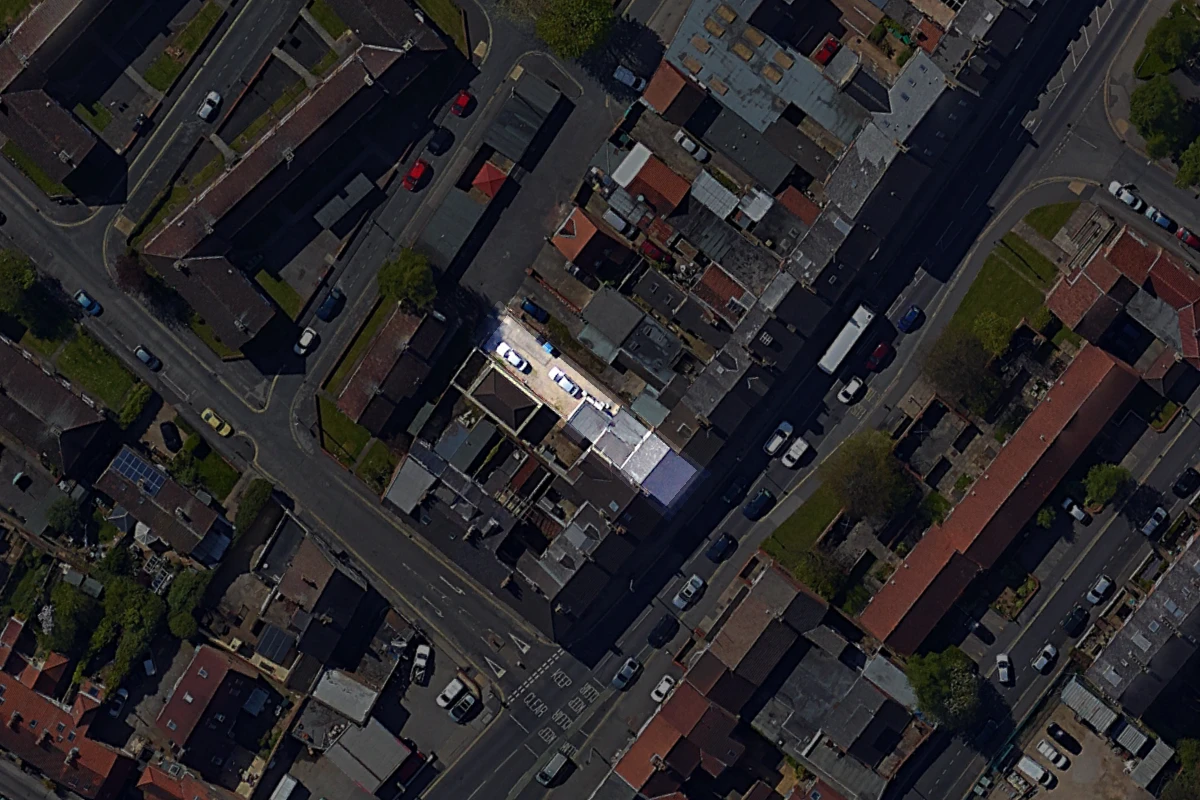
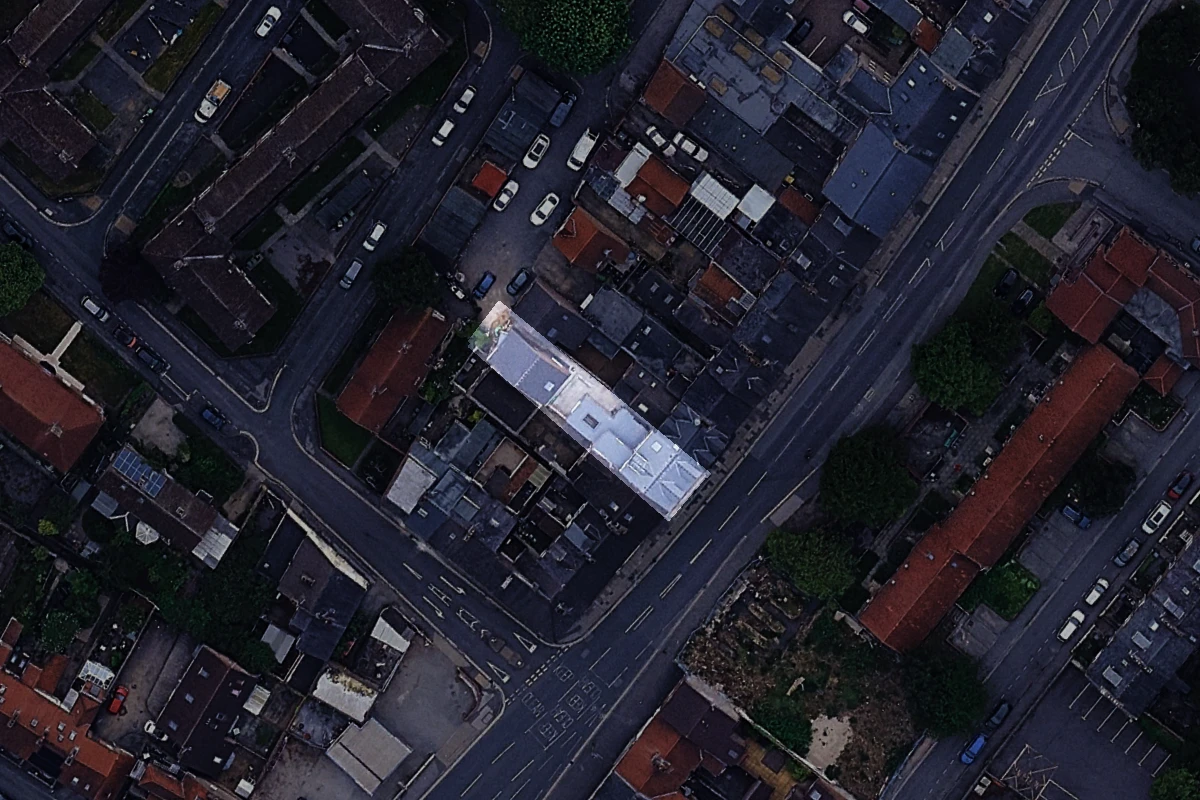
The former Boots Clarence Street branch served the local community from the ground floor of a traditional terrace. However, as retail footprints consolidated and local shopping habits evolved, the commercial unit eventually fell vacant. Fining Associates, a York based Architectural practice, was tasked with reimagining this redundant site. Our approach required looking beyond the obvious. Instead of a straightforward refit, we developed a comprehensive strategy to maximise the site’s capacity. By treating the plot holistically, we established a masterplan that delivered high-quality urban living in a highly sustainable location. This project perfectly encapsulates our core philosophy: Spanning the Breadth of Architecture.
Maximising density: one retail unit and a maisonette into six homes
The headline transformation of 66 Clarence Street is a masterclass in urban density. We started with a site comprising a single vacant retail unit at ground floor and one first-floor maisonette above. We finished with an approved scheme delivering six self-contained homes.
Achieving this required dividing the project into two parallel but cohesive planning applications. Application 21/00673/FUL focused on the conversion and extension of the existing frontage, yielding four flats (two one-bedroom and two two-bedroom units). Application 21/00554/FUL introduced an entirely new two-storey building to the rear curtilage, providing two further one-bedroom apartments.
This dual-application strategy allowed us to navigate City of York Council planning efficiently. It separated the distinct technical challenges of a heritage-sensitive conversion from the complexities of a new-build backland development. Both applications were ultimately recommended for approval, transforming an underutilised plot.
Adaptive reuse: transitioning from commercial to Class C3 residential
The host building at 66 Clarence Street dates back to approximately 1845. Like many structures in the area, it was originally domestic in scale before undergoing later commercial alterations at the ground floor. Our design strategy focused on adaptive reuse, returning the building to its residential roots.
The September 2020 Use Class Order changes consolidated former A1 retail uses into the broader Class E. Our conversion scheme moved the building wholly out of Class E and into Class C3 (residential). We acknowledge that a commercial frontage was lost in this process. However, the swap was entirely justified by the redundancy of the retail space; demand along this specific stretch of Clarence Street had definitively moved on.
To facilitate this transition, we removed the existing standard timber shop front. We implemented sympathetic detailing to integrate the new residential facade. We specified brickwork to carefully match the existing terrace and introduced vertically proportioned domestic windows. Furthermore, we aligned the new eaves and ridge heights precisely with the neighbouring property at No. 64. These architectural moves allowed the building to reclaim its inherent residential character, securing a viable, long-term future for the 19th-century structure.
Class MA permitted development vs full planning for shop conversions in York
When assessing shop-to-residential conversions today, property owners frequently ask about Class MA permitted development. It is vital to state that the following comparison applies exclusively to the front conversion (Scheme A, application 21/00673/FUL). The rear new-build (Scheme B, application 21/00554/FUL) constitutes new development and therefore always requires full planning permission. Class MA cannot deliver new-build architecture.
Class MA was introduced in August 2021 and significantly relaxed in March 2024, removing both the 1,500 sqm floorspace cap and the mandated three-month vacancy requirement. Because our application for 66 Clarence Street was submitted in March 2021, Class MA did not yet exist. However, comparing our full planning route to the modern Class MA framework provides a crucial lesson for anyone undertaking a similar conversion today.
Class MA covers the change of use only. It strictly does not permit external alterations. At 66 Clarence Street, our conversion relied on substantial external modifications to make the interior spaces work. We raised the eaves and ridge. We added two new front dormers matching No. 64, alongside two new rear dormers. We completely replaced the timber shop front with brickwork and domestic-scale vertical windows. We also replaced a lean-to pitched roof with a new flat-roof rear outshot concealed behind a crisp brick parapet. Finally, we introduced a side passageway giving access to the flats and rear yard. Every single one of these essential moves would have triggered a full planning application regardless of Class MA.
Furthermore, prior approval under Class MA is exceptionally narrow. It is limited to a rigid, prescribed list of matters such as transport, contamination, flood risk, noise, and natural light. There is virtually no mechanism for design control or nuanced negotiation. At Clarence Street, the dormer detailing, ridge alignment, fenestration proportions, and material palettes were all actively negotiated with the case officer to achieve a superior visual result.
Crucially, Class MA conversions are subject to strict, mandatory compliance with nationally described space standards. Two of our four flats at 66 Clarence Street — specifically the upper-floor 2-bed units — fell slightly short of the optional technical space standards. However, under a full planning application, the case officer was able to apply contextual judgement. Because these units offer generous double-sized bedrooms and excellent overall amenity, they were judged highly acceptable. That vital contextual flexibility is exactly what full planning permits, and what prior approval explicitly forbids.
The honest takeaway for developers is clear. For a straightforward Class E unit needing absolutely no external alteration, Class MA can be the faster, cheaper route. But for any conversion involving roof works, dormers, a replacement frontage, or unit layouts that require a planner’s seasoned discretion rather than a binary tick-box test, full planning earns its keep. Under Class MA, you simply get a change of use. Under full planning, backed by careful design and proactive engagement from architects in York, you get a fully realised building.
Backland development to the rear yard
The rear of the Clarence Street plot consisted of underused hardstanding. We identified this as prime land for backland development, tapping into an established local pattern, where neighbouring plots feature mews-type dwellings fronting a private rear courtyard.
Our design for the new-build structure (Scheme B) delivers two one-bedroom apartments. Both achieve full compliance with the national space standards. The architecture features a distinctive catslide roof profile. This specific massing strategy presents a two-storey elevation to the access road but drops to a single-storey height at the rear, preserving daylight to adjacent gardens and preventing overlooking.
The apartment building is clad in red textured brick with a blue brick base, its slate pitched roof and striking first-floor zinc oriel window providing the building’s primary moments of character. The palette draws on the predominant material of the surrounding neighbourhood while the oriel — a deliberate set-piece in the elevation — gives the building a contemporary identity of its own.
Environmental considerations were heavily integrated. The site is designated as Flood Zone 1, making it highly appropriate for residential development. We introduced permeable paving to the rear yard to improve surface-water runoff. The mews building also achieves a minimum 28% reduction in carbon emissions over Building Regulations Part L (2013) targets through efficient fabric and PV panels, alongside a strict water consumption limit of 110 litres per person per day.
Proactive engagement and statutory planning competence
Securing planning permission for six homes on a constrained inner-urban site requires rigorous technical competence and a willingness to engage. Fining Associates operated strictly in line with NPPF paragraph 38, adopting a positive and proactive approach with the local authority. We provided revised plans and accepted robust planning conditions to ensure an acceptable outcome.
We also faced a significant infrastructure challenge. Yorkshire Water issued a formal objection to the rear new-build because a 300mm diameter public combined sewer crossed the site, requiring a strict 3-metre stand-off. A survey was commissioned to establish the sewer’s precise position, and the building layout was subsequently amended by non-material amendment to move the structure clear of the exclusion zone — resolving Yorkshire Water’s objection without compromising the scheme’s viability or requiring a formal sewer diversion.
The Guildhall Planning Panel — the ward-level body of elected councillors with an advisory role in City of York’s development management process — formally objected to both original applications. Their grounds were overdevelopment of the site and, more pointedly, insufficient natural light and ventilation in the proposed kitchens. The kitchen objection carried real weight: converting a building with a deep commercial plan into four flats inevitably places some rooms away from primary elevations, and the panel looked at the drawings and found them wanting. The case officer disagreed. Working through both grounds systematically in the officer’s reports, they found the kitchens adequately served and the density justified under NPPF sections 5 and 11, recommending approval of both schemes regardless. A planning panel objection is advisory, not determinative — but it still has to be defeated on the record. That it was, on both applications simultaneously, is a measure of how thoroughly the technical case had been made.
Heritage-led design in York’s Central Area of Archaeological Importance
Building in York demands an innate understanding of subterranean history. 66 Clarence Street sits firmly within York’s Central Area of Archaeological Importance, a zone protected under Part 2 of the 1979 Ancient Monuments and Archaeological Areas Act. Nearby evaluations have historically indicated medieval and Roman deposits resting approximately 1.4m below the current ground level.
To navigate this legislation, Fining Associates coordinated the necessary statutory notices. For the front conversion, we secured an Operations Notice under Section 35 of the Act, which had to be served at least six weeks prior to development commencing. For the rear new-build, we agreed to a conditioned archaeological watching brief, which was carried out and completed during construction. This ensured that all groundworks were properly monitored, protecting York’s rich heritage while allowing vital modern housing delivery to proceed without unnecessary delay.
Delivering sustainable, car-free urban housing
A major success of the Clarence Street York project is its absolute reliance on sustainable transport. We delivered six new homes with zero car parking spaces. City of York Council accepted this approach entirely due to the site’s exceptional walkability. The location is just a five-minute walk from both York St John’s University and York District Hospital, and less than ten minutes from the city centre on foot.
To support this car-free approach, we integrated secure covered cycle storage for all six dwellings — four spaces for the front flats, two for the mews. Through intelligent architectural design and rigorous planning strategy, Fining Associates transformed a singular vacant asset into a multi-unit residential success, proving that strategic density and heritage sensitivity can comfortably coexist.
Frequently Asked Questions
Can you convert a shop to flats in York?
Yes, converting a shop to flats is highly viable in York, particularly following the September 2020 Use Class changes that moved retail into Class E. Depending on the extent of external changes required, this can be achieved either through the various Prior Approval methods such as Class MA or a full planning application.
Should I use Class MA permitted development or apply for full planning permission?
If your conversion requires no external alterations and strictly meets national space standards, Class MA is a faster route. However, if you need to alter the facade, improve the roofline, or require contextual flexibility on internal layouts, a full planning application provides the design control needed to create a better building.
What is York’s Central Area of Archaeological Importance and how does it affect development?
This is a statutory designation under the 1979 Ancient Monuments and Archaeological Areas Act covering much of historic York. If your site falls within it, you will legally require an Operations Notice or an archaeological watching brief before commencing any below-ground works.
Can a residential scheme in York be approved without car parking?
Absolutely. If the site is in a highly sustainable, walkable inner-urban location with excellent public transport links, City of York Council will frequently support car-free developments, provided sufficient secure cycle storage is integrated into the design.